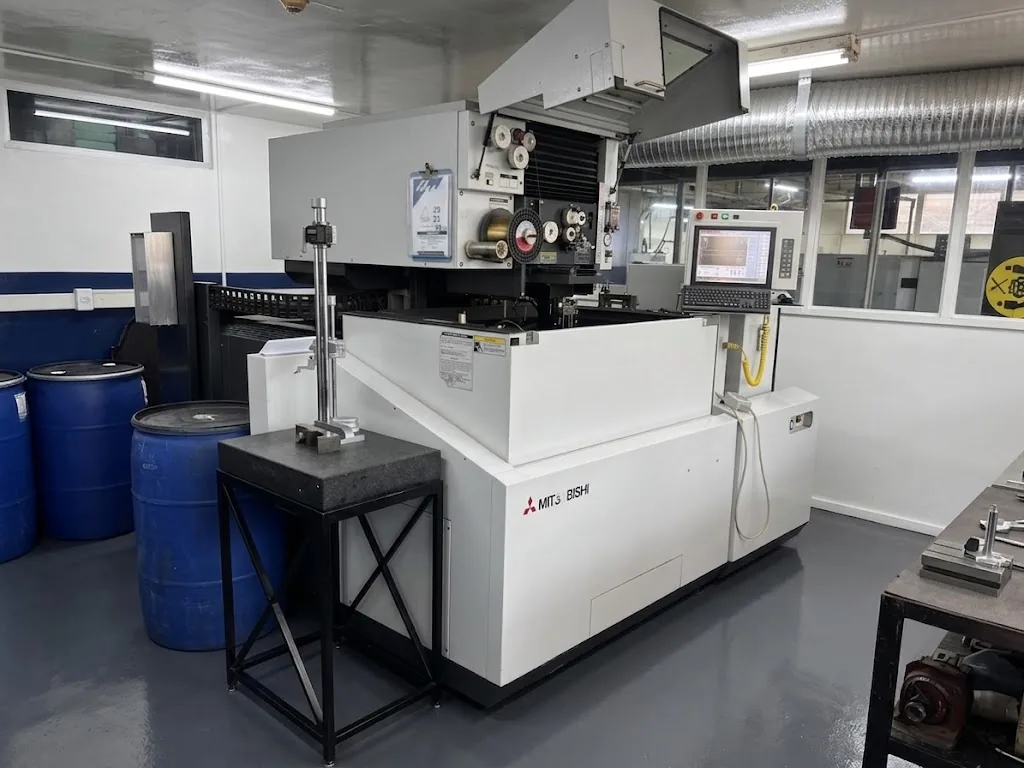
Erosionadora de hilo Mitsubishi MV2400S
600 × 400 × 310 mm
Pieza hasta 1,500 kg · conicidad 15° · hilo Ø 0.1–0.3 mm
Wire cutting in already-hardened steel, sharp corners, no cutting force
Service 04
Wire EDM, wire cut EDM, wire erosion, spark erosion — same process, different names. It cuts already-hardened steel, leaves an effectively sharp inside corner and puts no force on the part. It is one of the processes where we have the most machine time open right now.
The machine
One well-known machine with open capacity. If your part fits these travels, we can cut it.
600 × 400 × 310 mm
Pieza hasta 1,500 kg · conicidad 15° · hilo Ø 0.1–0.3 mm
Wire cutting in already-hardened steel, sharp corners, no cutting force
01
Final profile cut after heat treatment, so geometry is not lost in the furnace and corners do not round over.
02
Squares, hexagons, keyways and pockets where an end mill would always leave a radius.
03
The wire applies no force to the part, so thin material does not deflect or chatter.
04
Verification profiles cut straight from hardened steel, matching the exact contour of the part being controlled.
05
Clean cuts to split assemblies or recover components without damaging the useful part.
06
When a tap or drill breaks inside an expensive part, wire EDM removes it without scrapping the part.
In wire EDM there is no contact and no cutting force: a thin wire generates controlled electrical discharges that erode material. That has three practical consequences that matter a great deal in tooling.
D2 at 60 HRC cuts just as readily as annealed stock. That lets you invert the classic manufacturing order: heat treat first, then define final geometry. The part no longer moves after its critical dimension is set.
An end mill always leaves a corner radius equal to the tool. Wire leaves a radius on the order of its own diameter — effectively a sharp corner. On a cutting insert, that difference is what decides whether the stamped part comes out with a burr.
With no cutting force there is no deflection and no chatter. Thin sheet and slender profiles can be cut that would lift off the fixture under milling.
Our machine has 310 mm of Z travel, so that is the maximum thickness, and the table takes workpieces up to 1,500 kg. Send the drawing and we confirm it fits before quoting.
Any conductive material: carbon and tool steels, stainless, aluminum, copper, brass and carbide. Plastics and ceramics are non-conductive and go through conventional machining.
Yes — this is where it makes the most sense. There is no special tooling to build, so a single part does not carry a disproportionate setup cost.
DXF or STEP with the profile is ideal. A dimensioned PDF also works; it just takes a little longer because the contour has to be redrawn.
Yes, and it is common. If your shop has no wire machine, send us the profile and we return the cut part. We work as overflow capacity and do not compete for your customer.
Upload your drawing or 3D model and get a formal quote within 24–48 business hours. If anything is missing from the file, we tell you the same day instead of leaving you waiting.